
David M. Scraggs
👨🏼🏫How did this get in here! Well, if I can’t promote a book or two on my own website, where can I?😎
When I was doing my teacher training I used to peer-review ESL classes and noticed that teachers often left a portion of the lesson for a game or fun activity at the end of class. There is nothing wrong with that, of course, but in many cases, the games used produced little or no learning value for the students. They were just time fillers until the bell rang. So I decided to write a book of games and class activities that were both fun and educational.
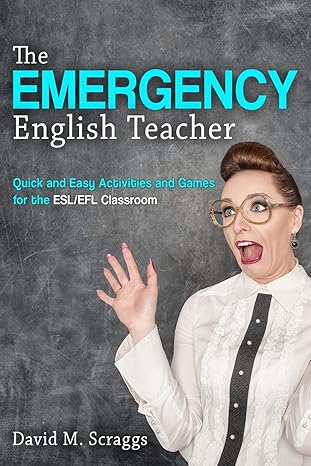
👨🏼🏫If you’ve taught English for any length of time, you’ll know that sometimes the best-laid lesson plans go out the window. The photocopier jams, the projector won’t switch on, or your boss suddenly hands you a class you weren’t expecting. All of these scenarios are perfect for picking up your copy of the The Emergency English Teacher and heading in to the classroom.
This book isn’t about theory, research, or long explanations of methodology. It’s about getting you through the lesson with fun and educational activities that require little to no preparation. In short, it’s a teacher’s survival kit.
How the Book is Structured
The book is divided into several chapters. At the head of each activity is a break down of the activity suggesting how much time it will take and what level of students the book is appropriate for. This is so teachers flicking through the book can quickly grab something that works for them.
- Blackboard/Whiteboard Activities – Despite advances in technology, the focal point of the classroom remains the board, and it provides an opportunity for a wide range of activities, games and quizzes.
- Speaking Activities -This provides the core of the book with two sections divided into standing up and sitting down speaking activities. The acitivities included are aimed at reducing any anxieties/ barriers the students may have about speaking.
- Vocabulary Activities– Games and tasks, riddles and puzzles that recycle words students already know or encourage them to expand their vocabulary. The teacher can adapt these to whatever topic they’re teaching.
- Drawing Activities– Communicative based drawing exercises to help develop students’ communicative strategy skills for describing objects and experiences in detail.
- Writing Activities
Small tasked based writing acitivities at sentence level . Nothing too heavy!
6. Quizzes and Stories
Why It Works
Practical: It’s designed for emergencies, but you’ll probably end up using the activities even when things are going smoothly.
Low prep: You don’t need to print anything or set up complicated materials.
Flexible: Most tasks can be scaled for small and large classes, teenagers, or adults.
This is my English teaching penknife and Im very proud of it…….Order your copy HERE