
Language Skills: Learning to use simple nouns, indefinite articles, and quantifiers
Lesson Time: 30 minutes
Student Level: Beginner
This lesson focuses on teaching nouns in the ESL classroom. It introduces the students to describing English nouns in their countable and uncountable forms. This is an important lesson because it aims to instill in the students, at an early stage, some correct habits when using nouns in their speech. By the end of this class, students will have practiced describing nouns in their singular and plural forms, as well as using quantifiers to define the amounts of nouns they are discussing.
The Lesson: Teaching how to talk about nouns
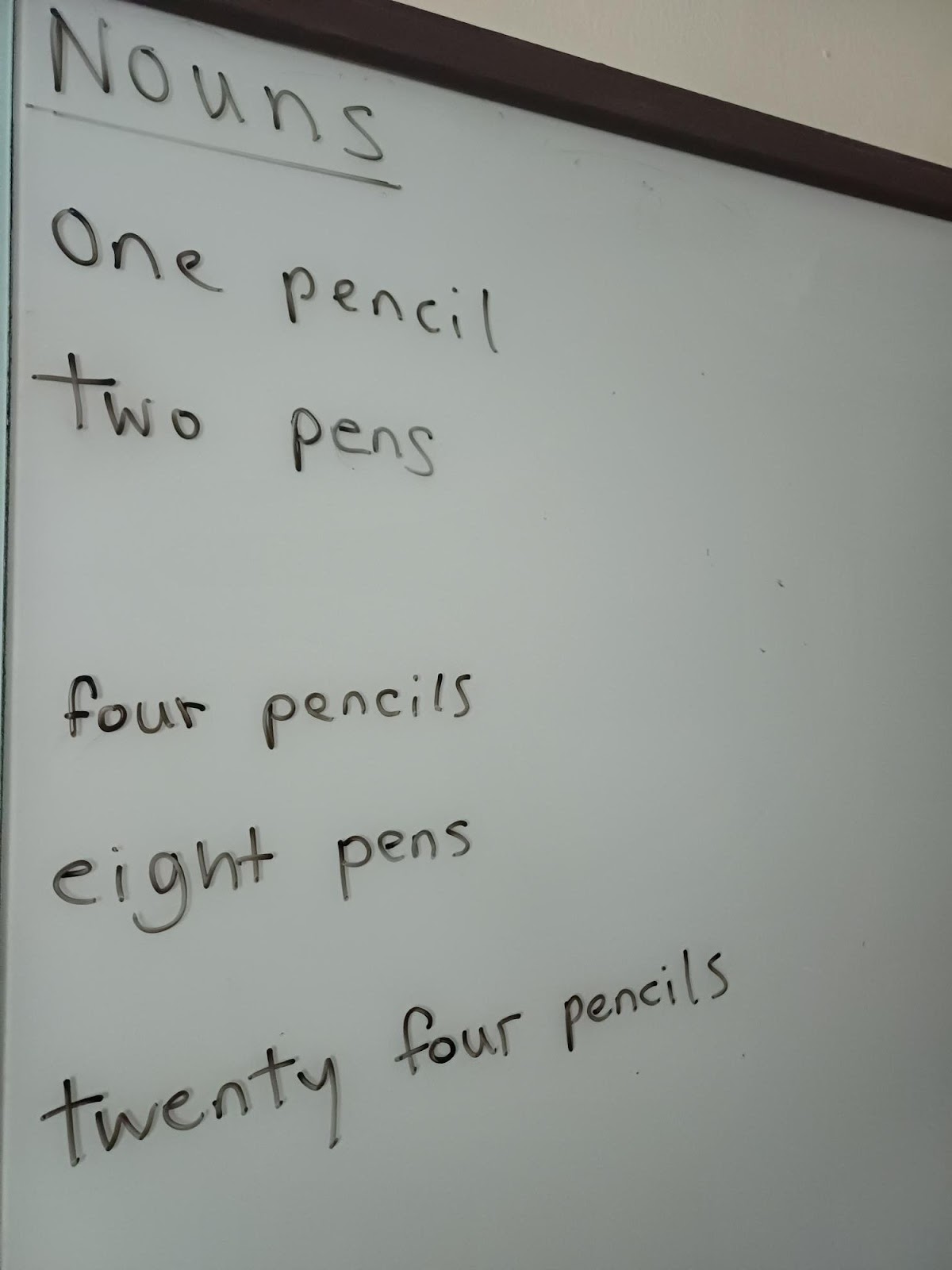
👩🏽🏫On the board, the teacher introduces some simple countable nouns, starting with the simple noun of….’ one pencil’.
The board photo shows one pencil! (It’s a slow start, I know, stay with me here!)

The teacher explains that nouns like ‘pencils’ and ‘pens’ are easily counted.
The teacher writes up ‘two pens’ and highlights the plural ‘s’.
Next, they write a few other plural noun phrases: ‘four pencils’, eight pens, and twenty-four pencils.
So at this stage, the board looks like this:
Introducing the ‘a‘ article
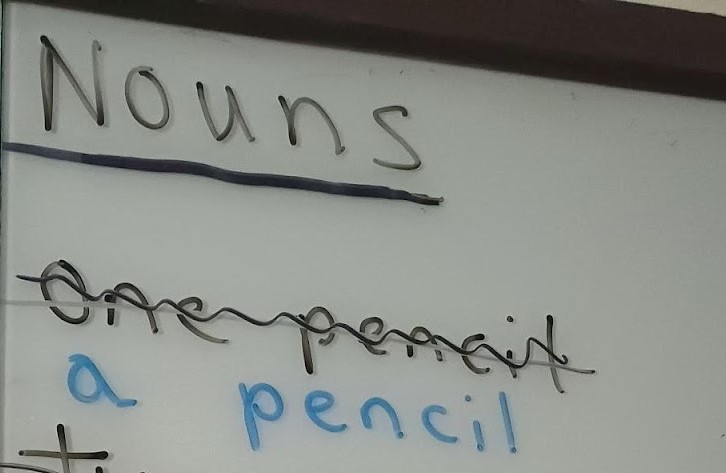
👩🏽🏫The teacher explains that in English, a single noun is preceded by ‘a (or ‘an).
The teacher crosses out ‘one pencil’.
Subtitle for This Block
Title for This Block
Text for This Block
Describing ‘a couple of’
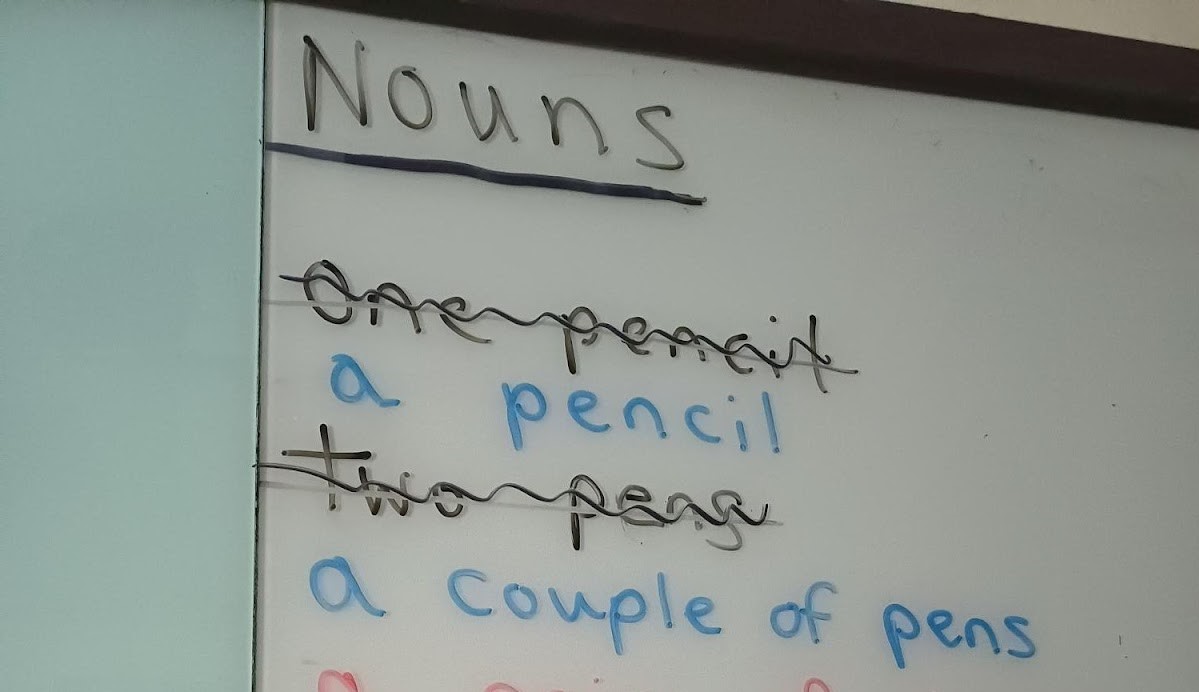
👩🏽🏫The teacher explains that in English conversation, we often omit stating the exact number of something and replace it with a quantifier.
Next, they explain that instead of saying the number ‘two,’ we often say ‘a couple of’. The teacher crosses out ‘two pens’ and writes out ‘a couple of pens’ (and so on with each example).
Describing ‘ a pair of ’
👩🏽🏫The teacher explains that in English conversation, we use the noun phrase ‘a pair’ to describe plural nouns that are units of two. For example:
jeans -> a pair of jeans
glasses -> a pair of glasses
The teacher gives examples of pairs found on the body. For example:
a pair of feet, a pair of hands, a pair of ears
The teacher explains how the pairs on our bodies lead to the equivalent pairs in what we wear/ put on. For example:
a pair of shoes, a pair of gloves, a pair of earbuds
Describing ‘a few’
👩🏽🏫The teacher describes how in English, if we have a small number of countable nouns, we often don’t say the exact number but say ‘a few’ to describe the small number. For example:
a few coins, a few keys, a few cash cards
Introducing uncountable nouns: Describing ‘a little’
👩🏽🏫The teacher starts a new column on the board for non-countable nouns.
Due to their nature, the teacher explains that we cannot count some nouns in English. For example:
rice
soup
money
rain
The teacher explains that small amounts of uncountable nouns are described using ‘a little’. For example:
A little soup
Describing ‘some’
👩🏽🏫The teacher describes how, in English, for an unspecified number of nouns, we use ‘some’
instead of the actual number. For example:
seven pencils -> some pencils
The teacher describes how ‘some’ can also be used with uncountable nouns to describe an amount. For example:
some rice
some soup
Describing ‘a lot of ’
👩🏽🏫The teacher describes how if there is a large number of a particular noun, instead of using the number, we use ‘a lot of’ or ‘lots of ’. For example, with countable nouns:
‘a lot of pencils’ or ‘lots of pencils‘
For uncountable nouns:
‘a lot of money‘ or ‘lots of money;
So at the end of all that…(if you are still following)….the board should look something like this:

‘many’ and ‘much’
👩🏽🏫Beginner students can get confused using ‘many’ and ‘much’ because they have to decide whether the object is countable and use ‘many’ or uncountable and use ‘much’. So I sometimes hear common awkward errors such as:
‘I have many money’
For this reason, at beginner and intermediate levels, I only teach the use of ‘a lot of / lots of’. This structure ensures that the students will always be correct.
Explaining when to use ‘an’ as an article
👩🏽🏫Students can learn when to use an article in just a couple of minutes, but it will probably take a little longer for them to always use it correctly (I guess they have enough things to think about!).
-To begin, the teacher writes up the vowel letters on the board: a,e,i,o,u
-Next, the teacher instructs that single nouns that begin with a vowel letter are marked by ‘an in English.
–The students are asked to suggest nouns for each vowel letter. For example:
an apple
an egg
an ice-cream
an octopus
an umbrella
Just as a small exercise, I write a list of nouns on the board and ask the students to write down the list in their notebooks and write ‘a’ or ‘an’ in front of each noun like this:
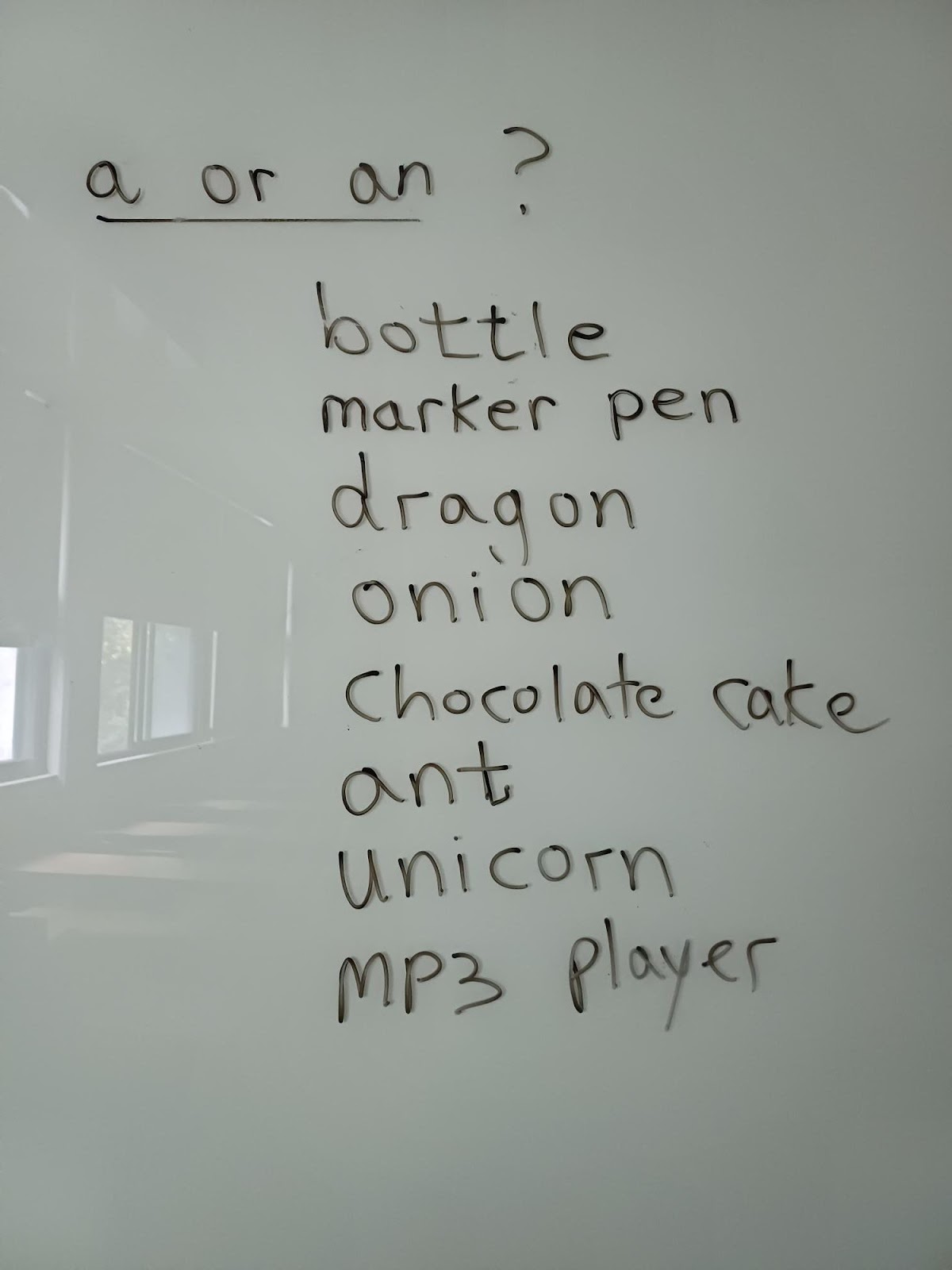
If you look at the bottom of the list, you can see a number of sneaky ones that students, following the rule, will make mistakes on. I do this deliberately because the students will focus on why the rule is wrong here.

an unicorn —> a unicorn
a Mp3 —> an Mp3
The teacher explains that the ‘a/an’ rule has nothing to do with spelling, but with the word’s phonetic pronunciation. Phonetically, unicorn begins with a ‘y’ /y/ sound, while MP3 begins with an ‘eh’ /ɛ/ sound.
Speaking Practice
👩🏽🏫Now that we have the basic target language on the board, it is time to practice speaking. The teacher writes on the board:
What do you have in your pockets?
-The teacher demonstrates how to answer by emptying their pockets and describing or writing down their contents using the grammar language points on the board. (Make sure you have a few good examples in your pockets beforehand, and nothing too incriminating! ) For example:
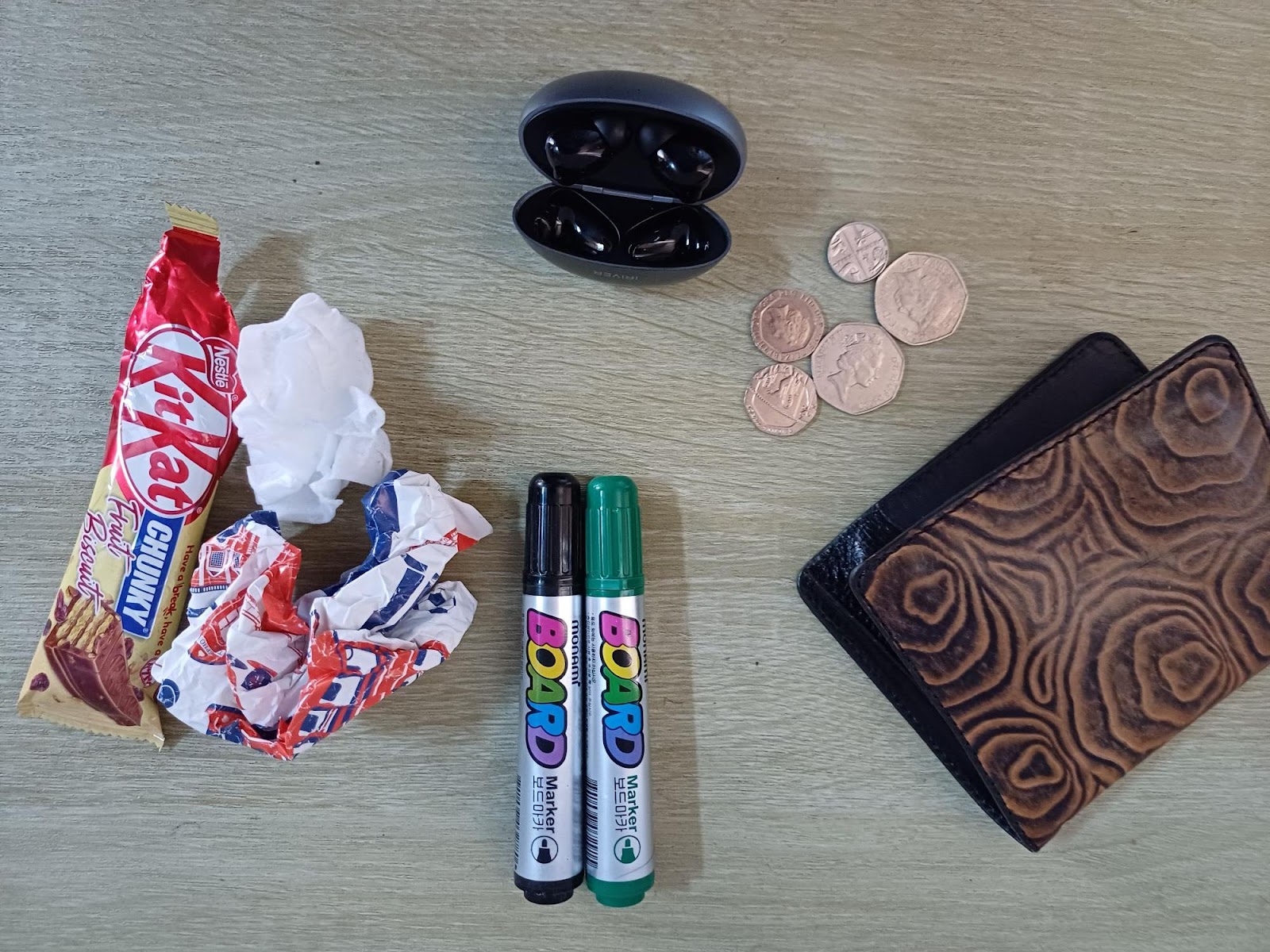
“I have a couple of board markers, a pair of earbuds, a few coins, some trash, and a wallet” (as seen in the heading photo)
-The teacher highlights the use of ‘and’ to signpost the last item on a list.
-The teacher expands the question and writes out:
What do you have in your pencil case ( wallet, purse, bag)?
-Students take turns with their partners listing the items that they have. The teacher monitors the class.
-After some practice, the teacher asks several students to describe what they or their partner has in their pencil case/bag.

This lesson should take about 30 minutes. If students perform the speaking task correctly, it may be tempting to move on to the next lesson; however, they will always benefit from some review exercises. Here are a couple of ideas:
The Shopping List
👩🏽🏫This is a fun and challenging review quiz for younger students. It challenges them to recycle all of the articles and quantifiers they have learned while trying to remember an increasing number of nouns.
-The teacher begins the exercise by writing the alphabet along the top of the board in large letters and highlighting the vowel letters.
-Underneath the alphabet, the teacher writes the beginning of a sentence:
“Last week I went shopping and I bought……..”
-The teacher then starts the exercise off by repeating the sentence aloud and finishing it with ‘an apple’ while pointing to the letter a on the board:
“Last week I went shopping and I bought…an apple”
-The teacher then repeats the sentence:
“Last week I went shopping and I bought…an apple and a balloon”
(pointing to the letters a and b on the board)
-The teacher then repeats the sentence:
“Last week I went shopping and I bought…an apple, a balloon, and a camera”
(pointing to the letters a, b, and c on the board)
By this time, most students will understand the activity. The teacher can pass it over to the students, who take turns repeating the whole sentence, memorizing what has been said by preceding students, and then adding an extra shopping item beginning with the following letter of the alphabet.
The students soon start to have fun by buying more bizarre items and attempting to trip up other students who are trying to remember an item that begins with the same letter. The exercise can be turned into a game where students are out if they cannot remember an item or say the wrong item. It can also be timed, with each student having to say their turn within a specific time.
Eventually, one student will triumphantly complete a whole ‘alphabet’ shopping list, without mistakes from ‘a to z’.
Noun review activity: Memory test (15 minutes)
👩🏽🏫For older classes, I review the lesson with a memory test.
If the class size allows, I place an array of items on a tray or desk, including examples that require the use of quantifiers learned in class.
– I let the students view the items briefly, about 10-15 seconds, and then cover them.
– The students then have to say or write down a list of all the items using the correct articles, plurals, or quantifiers.
For larger classes, I photograph the items and display the photo on a projector screen for 10-15 seconds.
………………………………………………………………………………………………………………………………………………………………………………………………………………………………………………………………………………………..
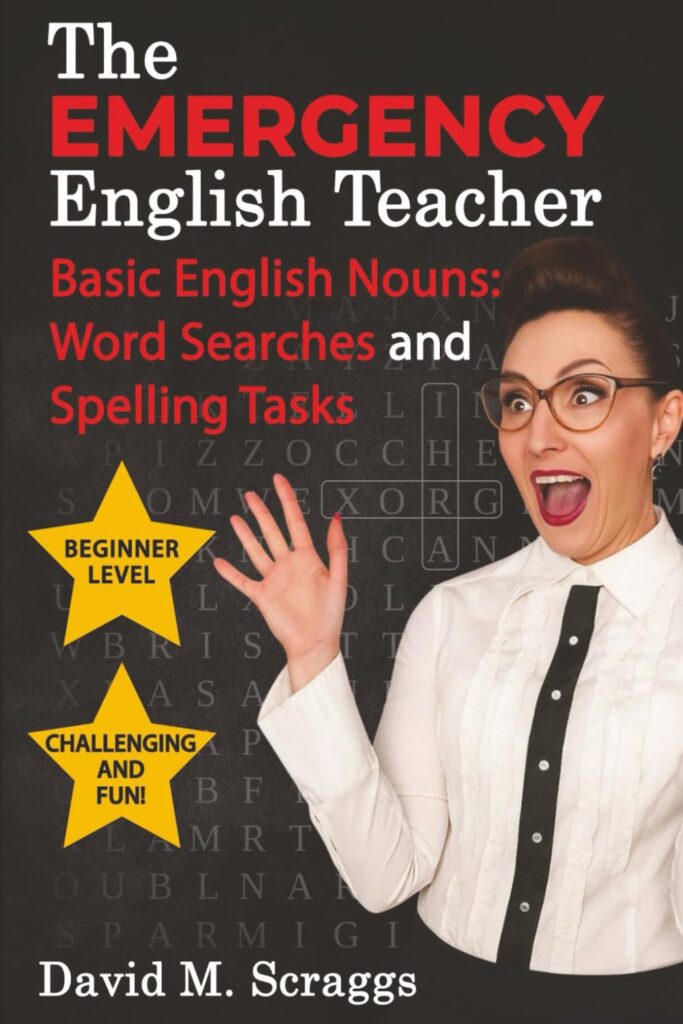
👩🏽🏫The most effective way beginner students learn and practice nouns is through engaging activities. I have designed a puzzle and spelling book aimed at helping young students learn and spell nouns in a fun way. The book covers 40 different topics in easy context situations.
Each puzzle helps students see, find, and spell new words, turning passive vocabulary into active learning. This interactive format keeps children engaged while saving teachers valuable preparation time.
✔ 40 themed word searches
✔ Matching spelling picture pages
✔ Perfect for beginner ESL/EFL learners
✔ No prep required — just open and teach
A practical resource for warm-ups, fillers, or quick vocabulary lessons , and a fun way for students to build confidence in English. Get your copy here!
………………………………………………………………………………………………………………………………………………………………………………………………………………………….
Now we have a lesson plan for teaching nouns in an ESL classroom. Next, let’s look at how to teach adjectives.