
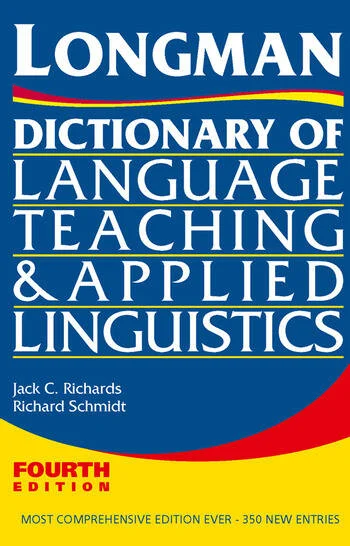
Jack C. Richards Richard Schmidt
👩🏫If you’re a language nerd like me and enjoy exploring the wonderful aspects of language and linguistics, then this is the book for you. At 644 pages, it’s coming in heavy, but I’m determined to read the whole thing. That is why it is in the magazine rack in my bathroom next to the loo! I’m currently up to E🙄. This is a great reference book for looking up obscure linguistic terms that make you appear intelligent. Linguistics is a language in itself, and as every language needs a dictionary, this book is it. Every term includes some suggestions for related terms, so every time I look up something, I usually find myself going down a rabbit hole of looking up all the new associated terms.
What the Book Does Well
1. It makes complex ideas understandable
👩🏫Applied linguistics is full of intimidating terminology, communicative competence, interlanguage hypothesis, lexical priming, washback, schemata, task-based learning… the list goes on. What this dictionary does brilliantly is break those concepts into short, accessible explanations without oversimplifying them.
Even better, many entries include examples, diagrams, historical notes, and references to major researchers, providing you with sufficient detail to understand both what a term means and why it matters.
2. It’s convenient for teachers
👩🏫This isn’t just a book for theorists. Classroom teachers constantly encounter ideas, curriculum design, testing, grammar terminology, learning strategies, error correction methods, and this dictionary explains them in ways that help you actually use the concepts in lessons and planning.
It’s handy if you teach university-level ESL, run CELTA/TEFL training, or write academic assignments. Many teachers also find it invaluable when preparing lesson plans that require a bit more pedagogical grounding.
3. It gives you the “big picture” of the field
👩🏫The dictionary covers hundreds of key researchers, linguistic theories, language-learning models, and methodological approaches. It’s one of the best tools for understanding how various aspects of language education interconnect.
If you’re studying for certifications, this book feels like a secret advantage, almost like a study guide disguised as a dictionary.
Who Will Benefit Most?
- ESL/EFL teachers wanting a more confident command of terminology
- MA TESOL or Applied Linguistics students who need a reliable academic reference
- Teacher trainers designing workshops or professional development
- Researchers who need a quick, authoritative check on definitions
- Curriculum writers who want precise, standardized terminology
If you’ve ever struggled through dense academic articles or puzzled over classroom methodology jargon, this book is a lifesaver.
Any Downsides?
👩🏫The only minor drawback is that it is not a casual read. It’s a reference book—meant to be dipped into as needed, not read cover to cover (that’s why it’s next to my loo!). Some entries are necessarily technical, and readers entirely new to linguistics may need time to become familiar with them.
That said, compared to many academic resources, it’s still very accessible.
Final Verdict
👩🏫The Longman Dictionary of Language Teaching and Applied Linguistics remains one of the most trusted and comprehensive reference books in our field. Clear definitions, authoritative coverage, and real classroom relevance make it an essential tool for teachers who want to deepen their expertise.
If you work in English language teaching at any level, this dictionary deserves a permanent place on your desk. So invest in your craft and get a copy here!