
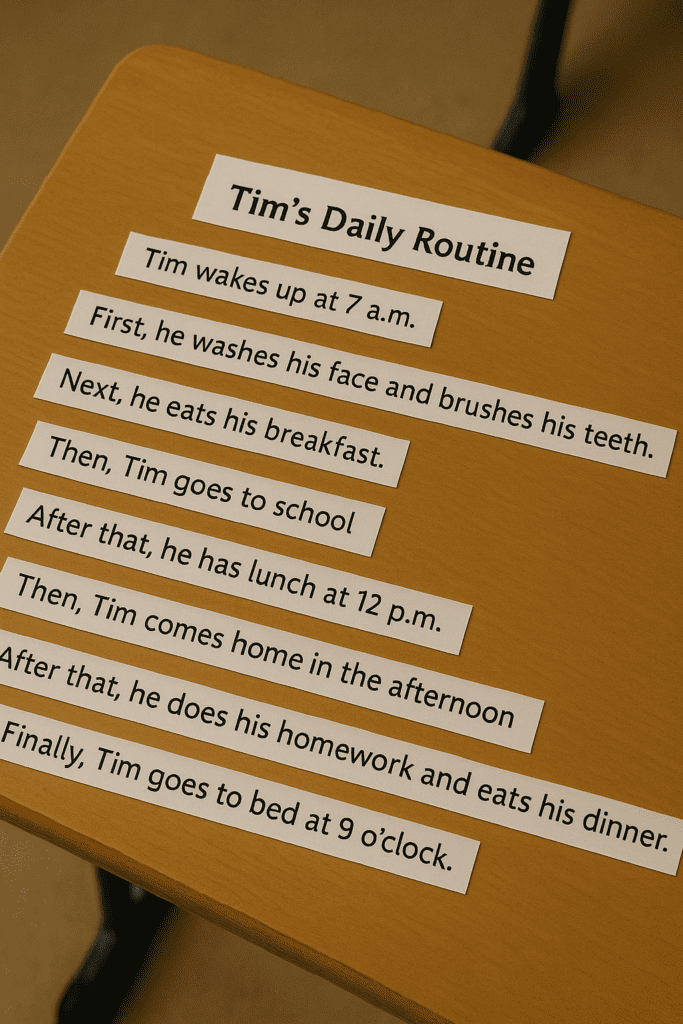
Tim’s Daily Routine
Suitable for: Beginner-level students
Lesson duration: 15-25 minutes
👨🏫 This simple lesson helps students develop basic reading fluency. In it, they read for understanding (gist) and for detail by arranging a list of activities that link together to form a daily routine. Most importantly, it also introduces the use of the FIVE SEQUENCERS, which allow readers or listeners to follow a story in a chronological order. The five sequencers are:
First – Next -Then- After that- Finally
👨🏫To prepare the lesson, the teacher writes out a list of simple activities that make up a daily routine. The routine can be as simple or as detailed as the teacher likes, depending on the student’s ability (I usually keep the routine to 8-10 actions for low-level/beginner students). Each line of the daily routine should form a clear chronological order.
Version 1
Before the lesson, the teacher:
-Writes out a daily routine on a sheet of paper.
-Prints out several copies depending on the class number.
-Cuts each sheet into strips with one daily action on each strip. Keep all the strips together with a paper clip.
During the lesson, the teacher:
-Divides the class into pairs.
-Hands out one set of strips to each pair of students.
-Instructs the students to arrange the strips to make Tim’s daily routine.
The students:
– Read through the strips together and arrange Tim’s daily routine in the correct order.
-The first pair to complete the routine correctly gets to read out the activity and wins a gummy bear.
👨🏫The slight downside to the activity is the time required to cut the paper strips. This is where a laminator comes in really handy, as it makes all materials recyclable for future classes. They only cost around 30 dollars, but for a teacher who has been in the job for a while, it’s worth its weight in gold. You will save hours on preparation work.
Version 2
This second version involves the whole class. The fun way to do it is to give the students a time limit to complete the task.
-The teacher hands out the activity strips of paper to the students.
-The students then have to walk around the classroom and read each other’s strips of paper.
-Then, have to try to find the student who is holding the activity strip behind them and the student holding the strip in front of them.
-When each student has found the position of the strip they are holding in the story, they stand in line in the classroom.
-So the student with the earliest activity stands at the front of the classroom, and so on.
-When the students believe they are in the correct line, they read out Tim’s daily routine in order.
-The teacher can tell them if they are correct or need to change their order. If they are correct, high fives and gummy bears all round.
(The thing to bear in mind in this version is that the number of students in the class must match the daily actions in the routine. So when you write out the daily routine, remember to make it flexible, where actions can be taken out or included as needed.)
See you in the next reading lesson right here!
