
👩🏾🏫Most ESL teachers will have had the experience of teaching in some rather sterile classrooms. A board, some desks, some chairs, and that’s about it. Sometimes it seems ESL classrooms are designed to be uninspiring. Perhaps the school principal wants to keep the classroom simple so that the students can focus on their studies. Who knows!
For me, the ESL classroom should be as stimulating as possible to aid students in their studies. The walls of an ESL classroom are more than just structural boundaries; they’re valuable real estate for enhancing language learning. A well-organized, thoughtfully decorated classroom can help students absorb vocabulary, reinforce grammar, and stay motivated. There are so many ways this can be done. The following are tips for using classroom walls with both younger and older learners.
Using Walls with Younger Learners
1) Class rules
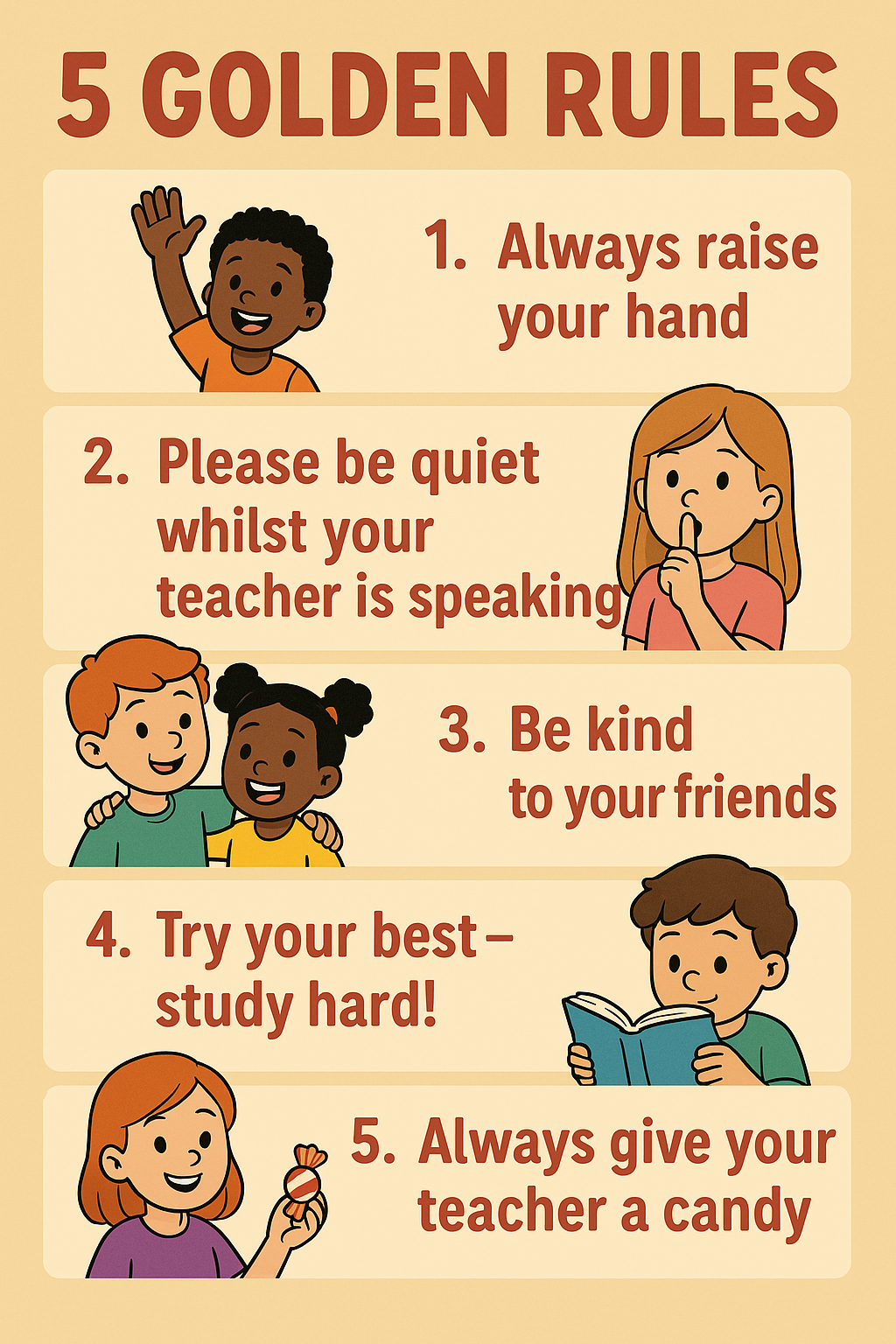
👩🏾🏫 The walls of the classroom can be used to display a short list of housekeeping rules for students to follow. There is no point putting up a list of twenty dos and don’ts in the classroom; instead, a short and sweet list is more effective. So you should give some thought to what you want to include on this ‘Golden Rule’ list. Once the list is up, you can review each rule with the students so they understand them. Anytime a student strays from a rule, you can point them to the poster to help them remember. Try it. It really works!
2) Displaying students’ work
👩🏾🏫Displaying students’ work on the classroom walls sends a powerful message: your English has value. When learners see their writing, drawings, or projects displayed, it builds pride and confidence. A wall display shows progress over time (for example, a “before and after” draft), so students notice how much they’ve improved. It also creates a sense of ownership; the classroom becomes their space, not just the teacher’s. Additionally, the displayed work serves as a learning tool. Students can read each other’s sentences, borrow ideas, and recycle useful vocabulary during activities.
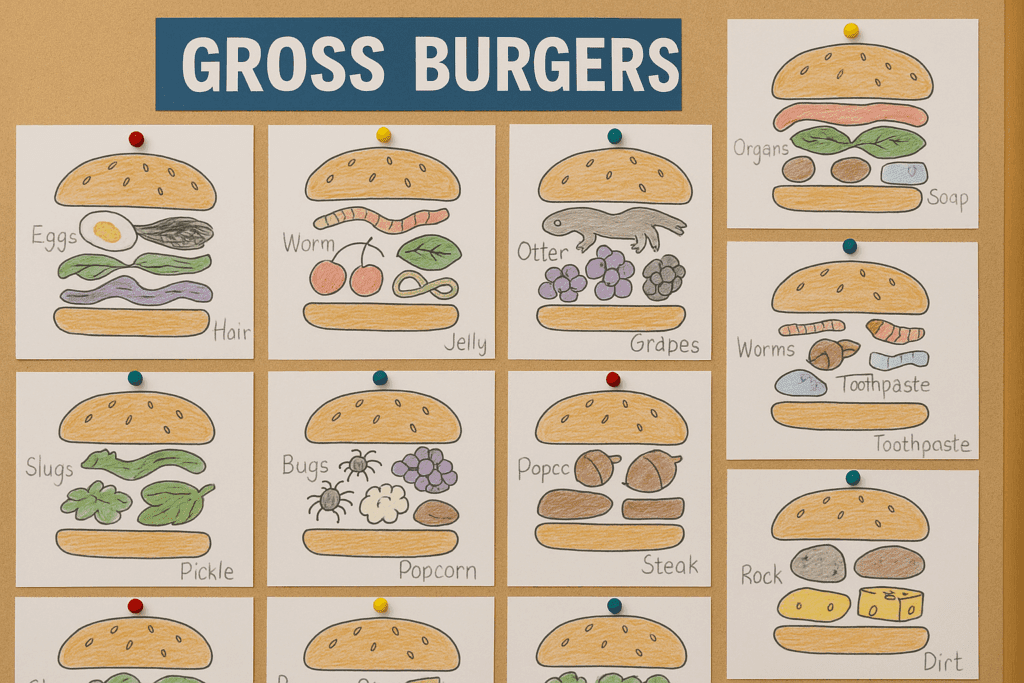
3) Frequent classroom questions/ expressions
👩🏾🏫Display some of the most common questions and requests the students might need to ask during the class on the walls; for example, ‘How do I spell? or ‘May I use the restroom? The students are well aware that the questions are there, and when it comes to using them, they can refer to the wall. Over time and frequency of use, they will internalize the language. Click here for more useful questions and expressions to use.
4) Themes
👩🏾🏫 Using rolling themes on the walls of a younger learner’s ESL classroom helps keep the classroom feeling new and fresh with each ‘makeover’. It’s a lot more work for the teacher, though!😆 When children see a themed wall, such as “Animals,” “Halloween,” or “My Family”, they are constantly reminded of vocabulary through pictures, labels, and simple phrases. This visual repetition helps children connect words with meaning, even when they are not actively being taught. Because young learners rely heavily on visual memory, thematic walls provide extra exposure that boosts retention and builds confidence in using new language.
Thematic displays also make the classroom an engaging and interactive space. A “Food” theme, featuring pictures of fruit and vegetables, can spark conversations at snack time, while a “Weather” wall with symbols representing sunny, rainy, and cloudy conditions encourages daily routine language. Changing themes throughout the year keeps students curious and motivated, while also connecting lessons to the world around them.
5) Maps
👩🏾🏫I have often walked into a classroom before a lesson and seen one or two students tracing their fingers over the world map on the wall. In a young learner’s ESL classroom, a map is both educational and inspiring for children. It sparks curiosity about different countries, places, and cultures. Young learners love finding their own country on the map; it gives them a sense of pride and belonging. A world map also serves as a constant, interactive teaching tool, and nearly every textbook will include content on different nationalities and flags. Teachers can use it to refer to countries when discussing animals, weather, and travel in a fun and visual way. For example, a question like “Where do kangaroos live?” can link to Australia, or a weather discussion can point to sunny versus snowy regions. Children learn best through visuals and play, and a big, colorful map encourages them to ask questions and make connections. In this way, the map becomes more than decoration; it becomes an active resource for learning and discovery.
Using Walls with Older Learners
1) Motivational quotes
👨🏫Using motivational quotes in an ESL classroom for older learners provides both inspiration and language input. Many adult learners can feel nervous about making mistakes or frustrated with slow progress, and short, powerful quotes serve as daily reminders that perseverance is part of the learning journey. A simple line, such as “It always seems impossible until it’s done” (Nelson Mandela), encourages students to persevere, while also demonstrating authentic, natural English in use. Because quotes are usually concise and memorable, they are easy to understand and recall, making them ideal for reinforcing both confidence and vocabulary.
Quotes also create opportunities for meaningful discussion and reflection. Older learners can connect the words of well-known figures to their own lives and experiences, which makes lessons more engaging and personal. Reading, repeating, and even analyzing motivational quotes build comprehension, introduce new expressions, and spark conversation practice. In this way, the quotes are not only motivational but also serve as authentic language material that combines culture, inspiration, and learning all in one. You can also ask the students if there are any quotes they would like posted on the wall.
2) Song lyrics
👨🏫Listening to a song in class is always a popular lesson. Afterwards, displaying the song’s lyrics on the walls brings a cool authenticity to the classroom. Many students already listen to English songs outside of class, so seeing lyrics on the walls connects their studies to real-life culture. Lyrics often employ everyday expressions, idioms, and conversational grammar, making them a valuable resource for learning natural language. Having them visible helps learners absorb phrases gradually, and the rhythm and melody behind the words make them easier to remember.
Music lyrics can also spark curiosity and discussion, providing learners with something meaningful to discuss. Older students may connect emotionally with a lyric about love, friendship, or resilience, and this emotional connection can increase their motivation to engage with the text. Teachers can use the lyrics as springboards for vocabulary practice, pronunciation exercises, or cultural discussions. In my class, after we listen to a song and study the lyrics, I ask the students if any lines resonate with them. If they like something, I’ll put it up on the wall for the next class. Here are a few examples of lyrics that have been stuck up on my walls:
- “You may say I’m a dreamer, but I’m not the only one.”, John Lennon, Imagine
- “Don’t worry about a thing, ’cause every little thing gonna be all right.”, Bob Marley, Three Little Birds
- “I see trees of green, red roses too. I see them bloom, for me and you.”, Louis Armstrong, What a Wonderful World
- “It’s my life, its now of never..I aint gonna live for ever” Bon Jovi, It’s My Life
3) Displaying Useful Language points
Displaying key language points on the walls of an adult ESL classroom is an effective way to provide learners with constant visual reinforcement. Adults often juggle many responsibilities outside of class, so they may not always have time to review notes or grammar books. By putting essential language points, such as verb tense timelines, useful sentence frames, or common collocations, on the walls, teachers provide a quick-access reference that students can glance at whenever they need support. This creates a more autonomous learning environment, where learners feel empowered to check their understanding without interrupting the flow of a lesson.
4) High Frequency Errors
Including high-frequency errors on the wall can be especially useful for older students. Many adult learners develop fossilized mistakes, such as dropping the “s” in third person singular (He work instead of He works) or confusing prepositions (in vs. on). A “Common Errors” wall, written in a supportive and positive tone, can highlight these patterns alongside the correct forms. By seeing these reminders daily, students become more aware of their own usage and gradually self-correct over time. This approach turns the walls into practical teaching tools, helping adults focus on accuracy while still encouraging fluency and confidence.
5) Realia
👨🏫Realia, authentic objects and materials from everyday life, can be compelling in an adult ESL classroom because they connect language learning directly to the real world. Adding realia to walls, such as menus, magazine covers, and job advertisements, helps students see how English is used in the real world outside the classroom. This makes lessons feel relevant and practical. Realia also sparks curiosity and conversation, as students can compare what they see with similar items from their own countries, turning the classroom into a space for cultural exchange and language practice.
Using QR Codes
These days, many printed items contain QR codes, which adds further value by blending authentic print with digital resources. A printed menu on the wall, for example, can have a QR code linking to the restaurant’s website, while a bus schedule could link to the city’s live transit app. This allows students to practice scanning codes, navigating English websites, and engaging with up-to-date materials, skills they will likely need outside of class. For adults who frequently use English for practical purposes, such as travel, work, or daily tasks, displaying realia with QR codes not only enhances authenticity but also fosters digital literacy in a fun, interactive way. This makes the classroom walls dynamic resources that go far beyond decoration.
5) Maps
👨🏫Older learners enjoy looking at maps too! They form a springboard for conversations about travel, culture, and identity. They are also a good focus for a geography quiz!