

👨🏫 Often, when I observe an ESL class, I watch a teacher explain a grammar point or an exercise for students to try. After they have finished speaking, the teacher asks the students the following question…..
“Do you understand?”
The teacher is then met by a sea of nodding heads, and is satisfied that the class has indeed understood their ‘clear and precise’ instructions. However, once the students start making errors or just sit there awkwardly, unsure what to do, the teacher has to walk around the classroom, micro-teaching things they have already explained. So what happened? After all the students had nodded to show they understood, the teacher. Well, here’s the thing (drum roll): they actually didn’t!
Because when a teacher asks a class, “Do you understand?” the natural reaction of the students is to nod. Such a scene is played out over and over again in classrooms all over the world.
So why does this happen? It is usually for one of three reasons.
-The first is due to peer pressure in class. Nobody wants to look like ‘the dummy’ who didn’t get it and lose face in front of their fellow students.
-The second is that they understood part but not all of the explanation.
-The third is that they don’t want to go through the ‘pain’ of having the teacher explain it all over again. Yawn!
So here are three solutions to the ‘Do you understand?/nodding heads’ problem…
The Hidden Thumbs Technique (great for younger students)
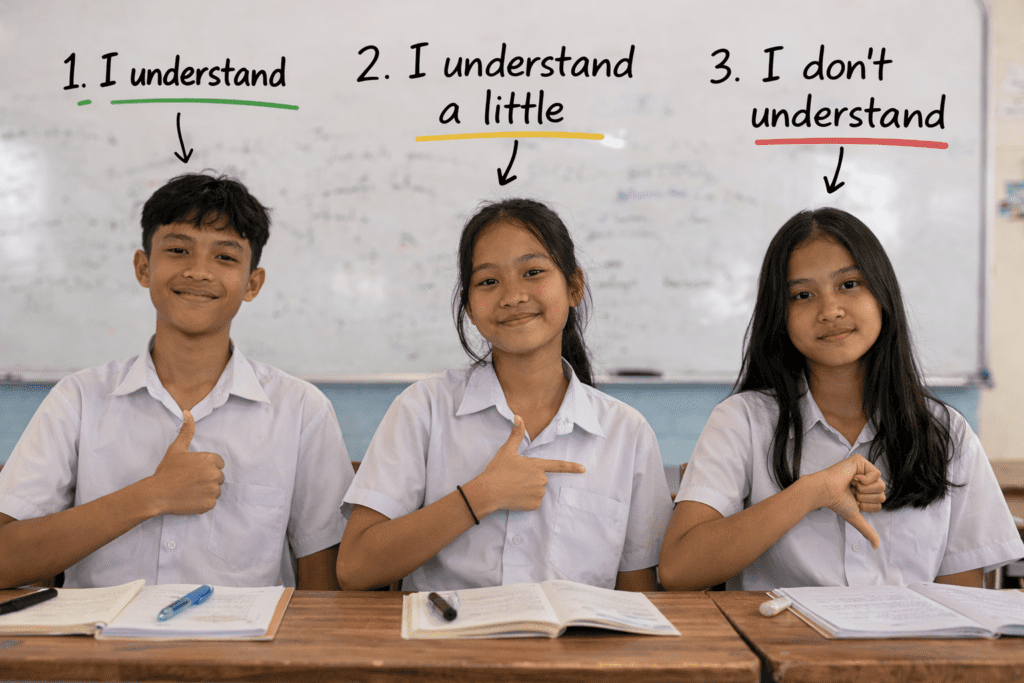
👨🏫A simple technique to check understanding is the thumb check. Instead of asking students to answer aloud whether they understand, the teacher asks them to give a quick signal with their thumbs on their chests. Students use three signals: a thumbs up means “I understand,” a sideways thumb means “I understand a little,” and a thumbs down means “I don’t understand.” Students hold the signal low on their chests so the teacher can see it easily, while classmates are less likely to copy one another. In just a few seconds, the teacher can scan the room and immediately see how well the class understood their instruction.
This technique works well because it removes some of the pressure students feel when speaking in front of others. Instead of raising their hand and saying they are confused, students can quietly signal that they need help. It also gives the teacher feedback from the entire class at once, rather than relying on one or two confident students. If several students show a sideways thumbs-down gesture, the teacher knows it is better to clarify the instructions or demonstrate the activity again before the exercise begins.
Concept Checking Questions: Yes, No, Short Answers
👨🏫This is the technique I use the most with older students. I like it because it helps me quickly confirm that the students understand the small details I want them to know. In effect, the students are telling ME exactly what I want them to do, pre-activity. It is particularly good for larger classes and gives me a sense that at least most of the class is on board, so they can go on to do the exercise whilst I can monitor around the class and troubleshoot any laggers.
Once I have given the instructions, I formulate questions that require only a one-word answer from students to show understanding.
Below is a simple example text passage that I want the students to read through in pairs. Two students have already read the passage aloud in class, and I have given the class instructions for reading it with their partners. On the right is the text passage, and on the left are my concept-checking questions.
“Ok, before you read through the text with your partner, let’s check on some things…”
👨🏻🏫Do I want you to read slowly or quite quickly?
🙋♂️Quite quickly
👨🏻🏫Do I want you to read through the conversation exactly?
🙋♀️No
👨🏻🏫Do I want you to change the people’s names?
🙋♂️Yes
👨🏻🏫Do I want you to change the city and countries?
🙋🏿♂️Yes
👨🏻🏫Do I want you to change the student’s majors?
🙋🏻♀️Yes
👨🏻🏫Should you read in a flat robot voice?
🙋🏽♀️No!
👨🏻🏫Should you read in a friendly voice?
🙋♂️Yes
In the College Cafeteria
A: Hi. Is this seat free?
B: Yes, it is. Please sit down.
A: Thanks. I’m James Kent.
B: Nice to meet you, James. I’m Yuki Kobayashi.
A: Nice to meet you. Can you say your last name again?
B: It’s Ko-ba-ya-shi… but please call me Yuki.
A: Where are you from, Yuki?
B: I’m from Osaka in Japan.
A: Oh, cool! I’ve heard Osaka is really beautiful.
B: Yes, it is…and how about you, James?
A: I’m from Toronto in Canada.
B: Oh, nice, my aunt lives there …and what are you studying here?
A: I’m studying Music. I play the saxophone.
B: Wow, that’s so cool!
A: How about you, Yuki?
B: I’m a design student. Actually, this is my first day. I feel nervous.
A: Don’t worry everyone feels like that at first.
So what these questions do is get the students to reaffirm exactly what I want them to do. After going through a simple set of CCCs like this, the student engagement in the activity will be much greater and more effective.
Concept Checking: Through deliberate mistakes
👨🏫A simple way to check whether students really understand your instructions is to deliberately say something slightly wrong and see if they notice. This works far better than asking “Do you understand?” because it forces students to actively process what you’ve said instead of politely agreeing.
This works particularly well with details students care about. When setting homework, for instance, you might say, “For homework, write twenty pages.” You’ll get instant reactions, laughter, complaints, maybe mild panic. That reaction is exactly what you want. You then check: “twenty pages?” and students will correct you: “No, two pages.” The key point is that every student now knows how long the homework is, not just the ones who were half-listening.
As another example, if the task is a pair speaking activity, you might say:
“Ok, you read Character A in a happy voice, and you read Character B. in a sleepy voice.”
Then pause and look around for a student to correct you
“No, Character B is in a sad voice.”
“Oh, that’s correct, and when you finish reading through one time, you just stop.”
“No, we change roles.”
“Correct… Ok, let’s go!“
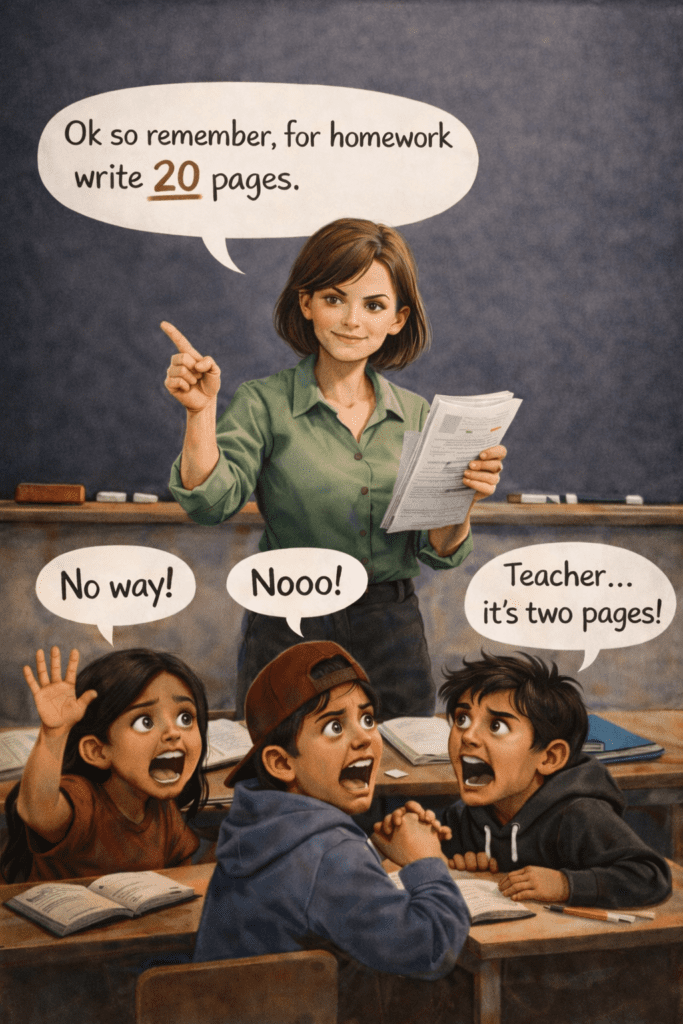
The strength of this approach is that it turns passive listening into active thinking. Students are no longer just hearing instructions; they are evaluating them. And in many cases, they enjoy catching the teacher out, which adds a small boost of energy to the class.
Used sparingly, this is a quick and reliable way to check understanding before an activity begins. If students can correct your mistake, they understand. If they can’t, you’ve just identified a problem early, before it turns into confusion halfway through the task.
Final Thoughts
Using these techniques is a habit, and, like all habits, as you practice them consistently, you will become much more efficient at using them. One thing is for sure: it is much better to employ them than to find out halfway through the activity that everything is already going wrong.